

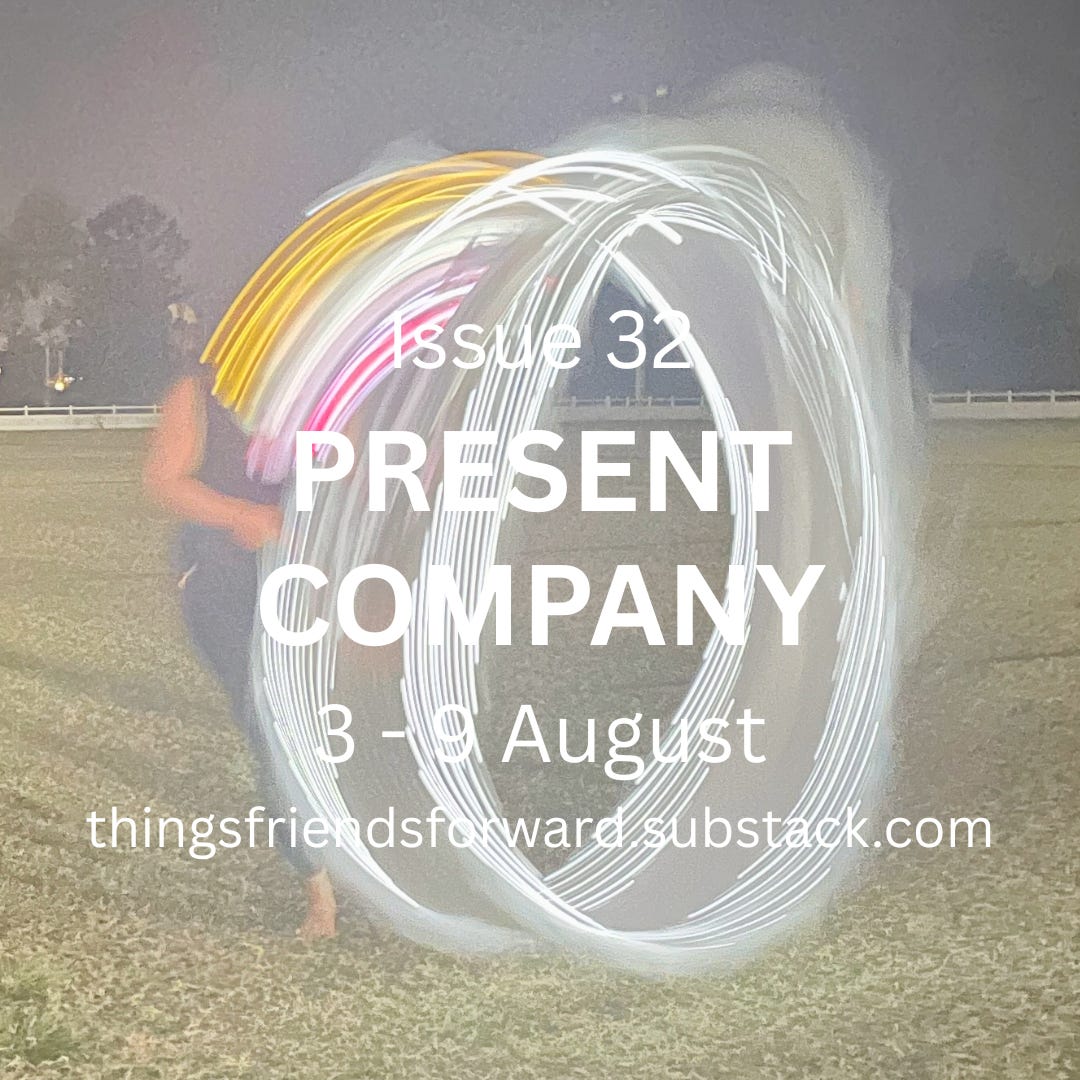
This week, I focused on my thesis, and the weekend was for socialising. Friday started with a quarry walk with Maritza and her sister Deidre - plenty of talk about community living and academia. Friday night rolled into the Mount Gravatt vegan markets with Adele, Asher, Cam, and Tom, where Adele showed off her dragon poi ribbon skills before good food and great chats. Sunday was a great morning at Brisbane Stoics discussing travel and transformation (see below), then an afternoon of reading in the park.
Here’s what I’ve been reading and listening to:
♫ MUSIC
For Phoebe Bridgers and planetarium fans, check out the Lost Weekend Planetarium Experience in selected cities in Canada, Europe, New Zealand, UK, US — including Melbourne and Wollongong in Australia.
Each listening session pairs the album with one of two original visual accompaniments: a custom dome show designed by renowned night-sky photographer Babak Tafreshi, or a unique immersive laser show designed by Laser Fantasy. Both presentations offer their own atmospheric perspective that turns your first listen into a shared sonic and visual experience.
Unfortunately, nothing is screening in Brisbane…
For Lucy Dacus fans, she’s featured on a few songs recently:
Clay Pigeons - from the “Sittin’ with Blaze: tribute to Blaze Foley” album
Madi Diaz - Heavy Metal (feat. Lucy Dacus) (UN-unplugged). Pre-order her album and watch her recent Tiny Desk Concert.
Smidley - Capstone featuring Lucy Dacus. Pre-order their album on Bandcamp.
Other new releases include:
Megasound “Dog Leash”
Cute dog video featuring Snoopy from members of Bad Bad Hats and Party Nails. Their debut album is out now, listen or purchase on Bandcamp:
Margaret Glaspy “Reminder”
Her album is out now too and was featured in Bandcamp Daily on 7 August.
Weezer - “C.E.O.”
Very cool cameo-filled video from Weezer!
Their new album out 21 August.
🗳️ POLITICS
Frustration is Not Loyalty: The number is not the story | Kos Samaras from RedBridge
Some measure of sanity with Pauline Hanson and One Nation being shoved down our throats incessantly. Kos argues that the polling for One Nation is at around 30%, but voting might not be the same. “It is a mood” as he puts it. When survey instruments record choice, they don’t tell “why the choice was made, and how firmly it is held”. His qualitative data keeps saying that One Nation votes are frustration “against the established order” and votes “against the entire political system”.
The next vote will take place in Victoria in November and will give some element of an answer. RedBridge’s latest Australian Financial Review write up had One Nation VIC support fall by 5 points, down to 22%, with the movement to (or back to) the Coalition.
Understand the psychology of these voters and the logic becomes obvious. They did not park their vote with One Nation because they read its policy platform… They parked it there because it was the loudest available signal of rejection. The protest was the message they wanted everyone to hear...
That is the crucial detail the topline hides. For a large share of these voters, the underlying objective was never to elect One Nation. It was to remove a government. One Nation was simply the sharpest instrument lying around at the time.
Kos discusses what the Coalition and Labor both need to do to act as credible, competent change agents and not just imitate and “fight on the terrain of grievance” (the Coalition) and talk with voters and not at them (Labor). “The Coalition is pulling on an open door, whilst Labor is pushing on a closed one”.
Restitching democracy: Unblocking the capillaries of power | The Future of Everything
Tim Dunlop discusses how party politics has detached from the concerns of everyday people linked with neoliberalism in the 1980s, dragging globalisation, privatisation, deindustrialisation, and growing state repression with it, and asks how we can reengage ordinary citizens.
It is about the formal and informal reinvigoration of public spaces as a way of encouraging us to speak directly with each other as members of a community—and ultimately a nation—outside the infinitely corruptible spaces of various forms of media.
Without this social foundation, no amount of formal political process will save us. But this doesn’t mean we don’t need the formal political process as well; and that’s the thought I wanted to continue with.
He traced this back to the 2022 election, when a broadly progressive coalition had its moment and squandered it: “The Coalition imploded in a fit of culture-war-driven factionalism. Labor capitalised, consolidating their position within this hollowed-out structure, as their actual support remained a mile wide and an inch deep.” No “commitment to genuine, inclusive reform”.
Tim also references Anton Jäger’s essay Hyperpolitics in Command? which argues recent political engagement has been modelled on online life: swarms, and high emotions with some bursts of activism, outrage, and burnout, followers, and witch hunts, dependent on an “influencer-style figurehead with an outsized grip over the organisation” (think Trump or Reform’s Nigel Farage) who lack the organisational tools of real mass politics to make change stick.
The Guardian’s interview in Anton, a lecturer in the history of political thought and theory, digs into his recent book, Hyperpolitics: Extreme Politicization without Political Consequences on the same theme. We’ve moved past mass politics, post-politics, and antipolitics into “hyperpolitics” - where we find ourselves now:
Politics is no longer something that you see as effecting large-scale social change, and the forms of liberty that are available to you are now more private, more intimate, more individual. At the same time, the idea that you can collectively bundle together with other individuals and change society starts to appear very, very remote.
Royce Kurmelovs from Deepcut News rounds up a selection of moments when the Albanese government has bent to lobbying pressure — from the left and the right — across a run of issues, including:
AI and datacentres: There’s already public opposition in Australia and worldwide over AI company stability, deskilling, labour impacts, and climate/water use
Gas tax: More than three-in-five Australians support one — did you know that the government earns more in HECS repayments than from the Petroleum Resources Rent Tax?
Supermarket Duopoly: 83% of voters say the supermarkets deserve some blame for the cost-of-living crisis
North West Shelf (Woodside) extension to 2070 - beyond the 2050 Paris Climate Agreement target
Gambling ads: three in four Australians want them banned — see how much the gambling industry has donated to Labor and the Coalition, and how much the AFL and NRL are making from societal losses
Hate speech laws (but only when anti-Israel): 79% Australians hold a negative view of Israel
Salmon farming: major community objections over the health, animal welfare and environmental impact from the floating fish pens in Tasmania
🏛️ PHILOSOPHY
Seneca’s Letter 28: Travel as a Cure for Discontent
On Sunday at the monthly Brisbane Stoics meet up, we discussed Seneca’s Letter 28, the message, how we can apply concepts, key phrases, metaphors, and the links with Stoicism broadly.
Seneca is writing to Lucilius, who is forever travelling but cannot shake his malaise. Seneca says that he needs “a change of soul rather than a change of climate”, as Socrates said, “you take yourself along wherever you go”; only when you can understand what is at fault can you begin to solve it.
Here’s a quote:
The person you are matters more than the place to which you go; for that reason we should not make the mind a bondsman to any one place. Live in this belief: “I am not born for any one corner of the universe; this whole world is my country.”
If you saw this fact clearly, you would not be surprised at getting no benefit from the fresh scenes to which you roam each time through weariness of the old scenes. For the first would have pleased you in each case, had you believed it wholly yours. As it is, however, you are not journeying; you are drifting and being driven, only exchanging one place for another, although that which you seek,—to live well,—is found everywhere.
The room was set up in a circle; we were all facing each other and could see each other when speaking. People shared with real vulnerability, and questions came up for guidance and clarification. I talked about my travels and what I call “travel as transformation” (see my video about my pre-study example) — how dealing with the comedown from travel, and the return to reality, helped me process my metaphysical travel (my mushroom trip) recently, as well as its integration. Not just going somewhere to escape, but travelling intentionally and slowly: befriending the locals, doing what the locals do, putting in the work while you’re somewhere new.
There were a lot of newcomers there and it felt great to do some mentoring and give direction in this space too. Around 30 of us — all ages and genders — getting together on a Sunday morning to discuss deep Stoic concepts - love it! I hope to see you at future events.
💡 STARTUP SPACE
If you are running a startup in Australia, like me, or supporting startups here, make sure you’re counted in the largest survey of Australia’s startup ecosystem.
I’ve been contributing to this for a few years now — since Startup Muster was founded in 2013, it’s cool to see comparison charts as you fill in the survey.
🚗 TRANSPORTATION
Big US‑style trucks are killing more pedestrians in Australia – our research proves it | The Conversation
Here’s another one for the files of “if America is doing it, let’s not”.
Pedestrian fatality rates are rising while drivers and passenger fatalities are stable. Vehicles in Australia are getting bigger in an effort to protect their occupants, but these “yank tanks” are more dangerous to those outside them. SUVs accounted for 25% of vehicles sold in Australia in 2012; by 2023, that had more than doubled to 57%.
This study looked at pedestrian crash data against the size and weight of the vehicle involved, and found that:
Every additional 100 kg of vehicle weight raised the odds of a fatal outcome by 6%
Every additional 10 cm of height raised those odds by 11%
Utes and US-style pick-up trucks carried around 60% higher risk than conventional passenger cars
Height mattered more than weight — likely because of where it hits: upper body, chest, or head
The authors concluded that Australia is following the same pattern the US saw — bigger vehicles, worse outcomes for pedestrians — just earlier in the transition, and that without policy change, it's likely to keep heading the same way.
The Danger In Front Of You: Bigger Vehicles Create Deadly Blindspot For Kids | WTHR
It reminds me of this visual from nine years ago — before front-view cameras and sensors were more prevalent in cars — showing just how large the blind spot on these vehicles can be. It’s called a “frontover”: a front blind spot where the driver cannot see what’s directly in front of their vehicle, and the danger increases with vehicle size.
This video measures how many children need to be sitting in front of a car before the driver can spot them (see from 03:04). In the clip, one driver needed at least 9 children lined up before noticing them; another needed 13 — a blind spot of 15 feet (4.5 m)! This impacts 93% of children under the age of six, and in 61% of frontover cases, the driver knew the child.
📺 TV SERIES
The Dark
6 episodes | ITV & ITVX & 🏴☠
This is a great Scottish serial killer thriller featuring Laura Donnelly, who I’ve just finished watching star in Sugar! Strongly recommend.
I’m grateful for quality time with friends, deep discussions, the ability to share my experience and knowledge with those who need it, and not-too-cold winter in the Sunshine State!