
031: Native Ground | 27 July – 2 August
Banned books and reading as resistance, the AI safety scorecard nobody's passing, and why breaking up your sitting sharpens your brain

A week heavy on socialising and steady on the strength training. Monday was dinner with Jordan, Adele, and Asher at King Tea in Paddington — we had a vegan banquet. I helped Christine with the clean-up for the hot yoga studio handover, which she called my "yoga of Seva": the art of selfless service, giving time and energy to something bigger than yourself.
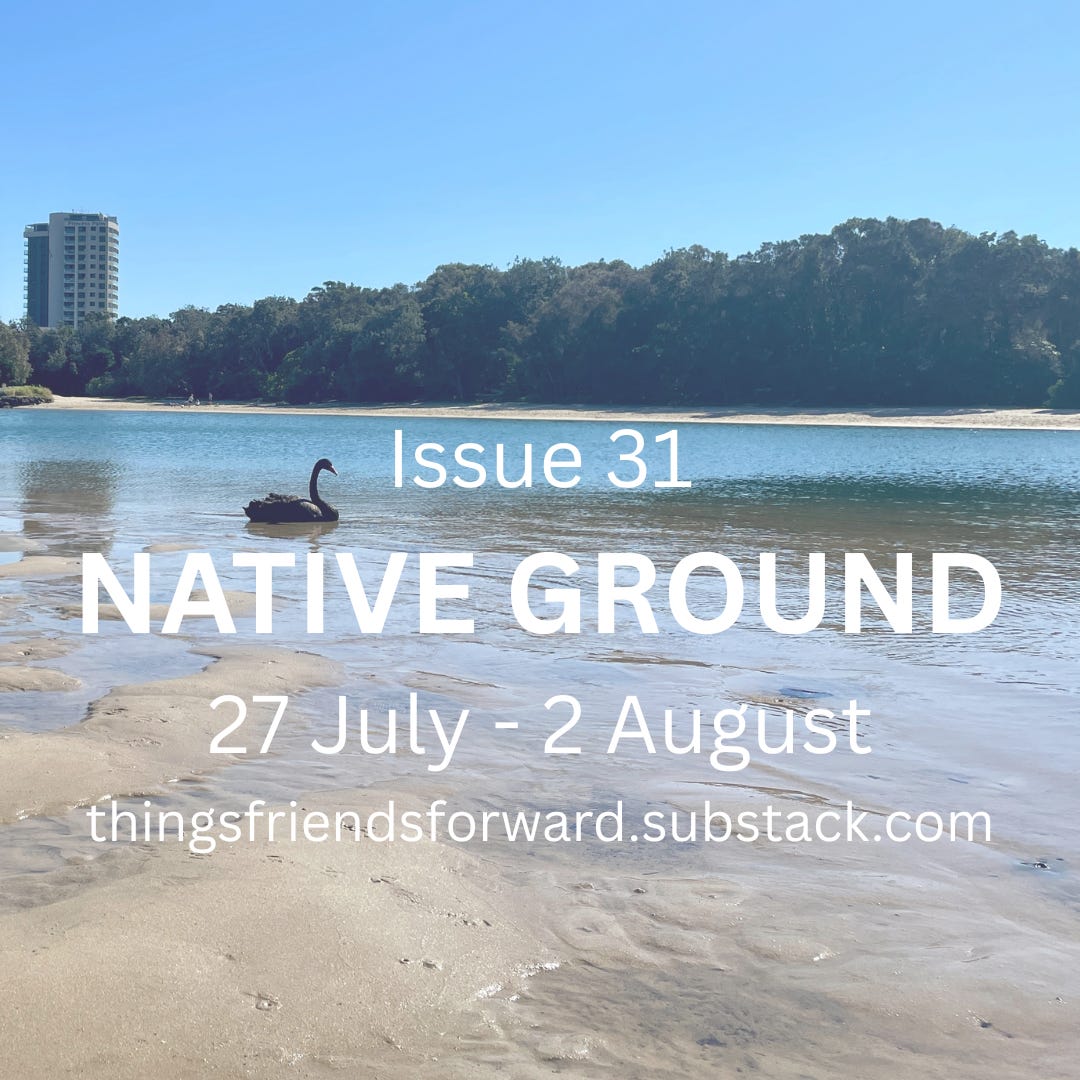
Thursday was a girls' day at the beach with Cat, Maritza, and her friend Nat. Here’s a photo of us (L-R: Cat, Nat, Maritza, and LC) with the chia puddings I made:

Here’s what I’ve been reading and listening to:
📚 BOOKS & READING
LOVE this from Ryan Holiday:
We Built a Banned Books Library in a Conservative Hotbed
“Don’t make your opinion someone else’s problem”
From Ryan’s July Reading List newsletter:
Some of the comments have been absolutely insane to me. Apparently if a book is available anywhere, it’s not actually banned? Tell that to the librarian who got fired?! It’s a nonsensical argument. In the antebellum [before the war] south, “Uncle Tom’s Cabin” was banned and criminalised. The fact that you could still buy it in Boston doesn’t cancel that out! And it’s still happening! In 2024, the ACLU had to file a lawsuit to restore access to “1984” in a Colorado school district! It would be funny if it wasn’t true. Just last year, the U.S. Naval Academy removed 400 books from its library for being “too woke.” My talk on wisdom was cancelled because I was going to say that that was stupid (I wrote a whole NYT article about it). So if you’re passing along any of these tropes or rationalisations, just know you are complicit. If you’d like to be part of the solution, send a book to the library or just come say hello.
Following on from this:
Children Who Read Are Harder to Control | Nicole Hemenway
Children who love to entertain and inform themselves away from devices managed and watched by the AI oligarchy are harder to surveil and they are harder to control....
As are adults.
I love how she discusses invasive species and the need to protect native ones:
Screens don’t colonize children’s attention because they are irresistibly powerful, but because the attentional ecosystem has been left bare. Reading isn’t the opponent of screens — it’s the incumbent species that holds the soil, and makes the invasive’s establishment harder because the ground is already claimed.
Commentary: The value of men’s book clubs amid the male loneliness epidemic
A good story about the need for male book clubs in Singapore.
Did you know elderly men (aged 61 to 96) were twice as likely as women to be “socially disconnected”? Those aged 21 to 34 were more likely to report higher levels of loneliness than other age groups, suggesting many young men may also be struggling.
With male suicide rates in Singapore higher than women’s — in line with international trends — and men less likely to seek mental health services, book clubs encourage stepping out of your comfort zone and building a daily habit of long-form reading, even just 15 minutes.
Benefits of long-form reading that short-form content doesn’t deliver:
Exercise attention at length, along with other mental muscles
Critical thinking and engagement with the text
Imagination gets a workout as we fill in the blanks
Reading both fiction and non-fiction broadens our ideas
Building the habit and sharing our reading with others helps it stick — especially for children, whose brains are still developing
🚗 ELECTRIC VEHICLES
What are your views on Australia’s electric transport networks?
If you’re an AEVA member — or you just want to give your views on Australia’s electric transport networks — please fill in this survey.
Note that “EV applies to electric vehicles (including cars and motorcycles) capable of being charged externally, including Battery Electric Vehicles (BEVs) and Plug-in Hybrids (PHEVs)”.
🧘🏻♀️ HEALTH, FITNESS, & LONGEVITY
Biohacker Bryan Johnson posts girlfriend Kate Tolo’s rigorous ‘menstrual cycle’ regimen + Bryan Johnson’s Girlfriend Wants to Share Her Body With the World | The Wall Street Journal (Archive.is)
Bryan Johnson’s latest longevity focus is on his partner Kate’s menstrual cycle. She’s following a strict four-hour morning routine to gather 14 million data points in what they’re calling a “first for female health”. She uses more than 50 devices to take daily measurements — including samples of her blood, urine, and stool, and a “techno tampon” that tracks blood-flow variations.
This comes after Bryan’s diagnosis with autoimmune gastritis, which I discussed in Edition 28, and after learning Kate has polyendocrine metabolic ovarian syndrome (PMOS; previously PCOS) and adenomyosis — where the uterine lining grows into the organ’s outer muscle wall — and that she’s long suffered severe pain during her periods.
Endometriosis is one of those conditions that just doesn’t get the kind of research funding that it deserves… I think of it almost like an autoimmune condition. It’s not a classical autoimmune condition, but the body’s definitely attacking itself. — Dr Sara Szal, director of precision medicine and longevity at the Marcus Institute of Integrative Health, Thomas Jefferson University
The Brain Benefits of Breaking Up Sitting | FoundMyFitness
From Rhonda Patrick’s newsletter, where she discusses a new meta-analysis that found breaking up sitting with some form of movement (30 seconds to 15 minutes) was associated with better executive function — the higher-order control processes that let us inhibit distractions, switch between tasks, resolve conflicting information, stay cognitively flexible, and regulate goal-directed behaviour — and better working-memory performance (our ability to briefly hold information, update it, manipulate it, and retrieve it in the moment) than sitting continuously.
The trials studied various forms of movement, with walking producing the most consistent positive signal for both executive function and working memory. Low-intensity activity looked particularly promising for memory. There’s no precise dose, frequency or intensity — which also means anything you do to interrupt continuous sitting helps. Keep in mind, though, that frequent interruptions were linked to greater improvement in executive function, but the opposite held for working memory: being pulled away from deep work is not ideal when you’re in the zone.
Movement breaks should not replace exercise. I think of them as a second layer of protection.
Structured aerobic and resistance training build fitness and physiological reserve.
Movement breaks prevent the rest of the day from becoming one continuous period of muscular inactivity.
So the solution is not to replace eight hours of sitting with eight hours of standing... you need more opportunities to move.
Rhonda suggests setting up your workspace like this:
Walk between focused work blocks (every 30–60 minutes, get up and do something — I make a tea, fill my water bottle, or walk outside in the sun when I’m on the phone)
Move at natural transition points (after a meeting, a section of writing, an email)
Change positions between walks (sit, lean, stand — I have a sit-stand desk, a yoga ball I sit and kneel on, a few balance and stretch items, and a couple of golf balls for my feet)
Use “micromovements” when walking isn’t practical (calf raises, arms overhead, a spinal twist)
Add vigorous exercise snacks separately (Rhonda is a big advocate for “micro workouts” — short bursts of movement that get you breathless, which I covered in Edition 27)
♫ MUSIC
Ninajirachi and Porter Robinson — WannaCry
Big electronic news: the official release of this collaboration (first played at Coachella a few months back) is finally here.
Buy it on Bandcamp. There’s also a great interview with them from Triple J.
Valley
Two new tracks from indie pop band Valley:
Someday
Vending Machine
Hopefully a new album is coming soon.
Miles Phillips — Eastern Rosellas (Full Band Version — with his dad, Joel)
An earnest, fun song, thanks to Lou
“Look at the beautiful colours”
Support him on Bandcamp, where you can even buy the karaoke version.
Who? “A kid from Australia whose dad helped him write and record his bird banger.”
There’s also a cute video where Miles is interviewed by his filmmaker dad. He’s now on the Triple J Unearthed list.
Other radio stations are playing AI covers and we’re playing this — Triple J Unearthed
🏛️ PHILOSOPHY
Want to join a Stoic research study?
From the Modern Stoic mailing list: Kat Merkelt is a trainee clinical psychologist and postgraduate researcher at the University of East Anglia in Norwich, England, who is researching Stoicism and psychological resilience.
The study explores the experiences of people who engage with Stoicism and how it shapes their ability to cope with and adapt to challenging situations. Learn more here.
Being free when we are constrained | The Stoic Gym
True freedom and creativity do not depend on the absence of constraints, but on being free despite constraints and creative despite limitations. Freedom cannot wait for political, economic, and social systems to change. Freedom cannot wait until all our problems are solved. Freedom cannot wait until we have enough money, possessions, or fame. Freedom must be found where we are right now. This is the very definition of freedom.
How do we get there?
Don’t outsource your freedom to externals like money, health, power, possessions, and reputation
Work on the freedom that depends on you — using the resources you control and can take responsibility for, and seeking clarity of action by living according to your values and principles
For the Stoics, the highest values were wisdom, justice, courage, and moderation. Everything else was secondary. As long as a person retained the ability to practice these virtues, their freedom remained intact.
🗳️ POLITICS
2026 Census Australia: Key dates, what’s included and why it matters | SBS Australia
Tuesday 11 August is Census night, when every person in Australia is counted — and experts say every answer matters. Some of us political and data nerds are excited: every five years the Australian Bureau of Statistics counts every person and household, whether you’re a citizen or not. At least one person per household must complete the Census, but you can fill out a separate form for privacy reasons.
What will you be asked?
Age, country of birth, cultural background, living situation, work, and education. Questions about religious affiliation, gender, and sexual orientation (for people aged 16 and over) will be optional.
It’s about us coming together as a nation, being seen, being captured in that family photograph and ensuring that the future of this country will be data-informed and policy will reflect exactly who we are.
Why does it matter?
The results need to be a national portrait of who we are now — not who we once were, or who certain groups would like us to be. Some of these aspects include religion, sexual orientation and gender, and cultural diversity.
In 2021, 38.9% of Australians marked “no religion”.
This year the Census adds questions on sexual orientation, gender, and “sex recorded at birth” to build a more accurate picture of LGBTQ+ communities in Australia.
Other new questions cover cultural diversity, health, households and families, and transport — including whether you ride a bicycle or e-bike to work, and the option to choose up to four cultural ancestries.
You’ll receive a letter in the mail with instructions for completing the Census online; some will get paper forms. You can also access it via your MyGov account IF you had subscribed to this option before 14 June.
How to complete the Census and what information you'll need
🤖 TECHNOLOGY & AI
AI Safety Index Summer 2026 Edition | Future of Life Institute
The fourth edition of the safety index, where independent experts grade nine leading AI companies on current harms, risk assessment, information sharing, governance and accountability, safety frameworks, and existential safety. As the scorecard below shows, it’s not great.
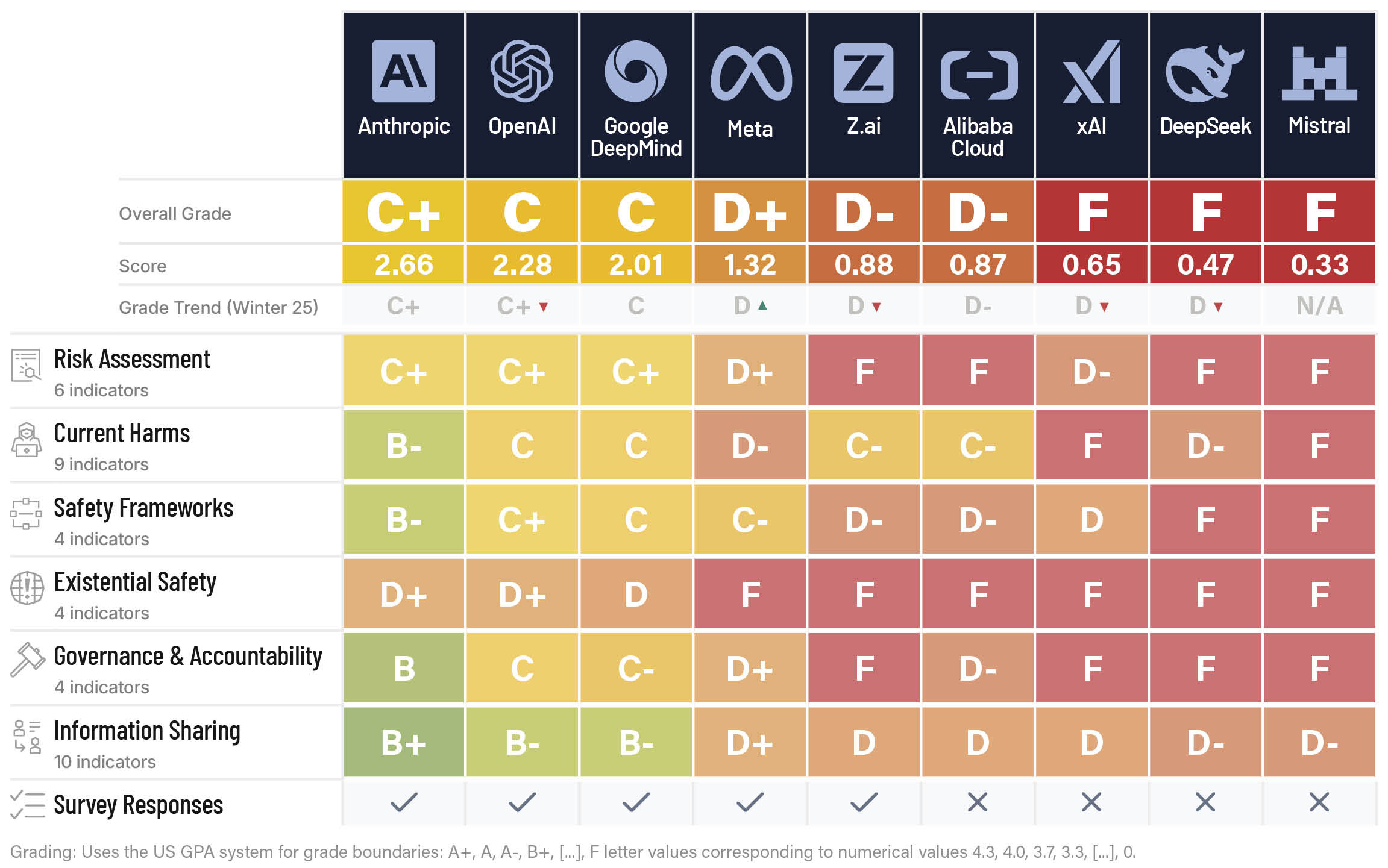
Some key takeaways:
Anthropic, OpenAI, and Google DeepMind stay on top
Meta improves; xAI deteriorates
Inadequate safety is a global problem, not a regional one — the three failing companies are American, European, and Chinese respectively
Reviewers flagged the industry’s pivot to military AI use as an emerging current-harm risk
The website lets you click into each scorecard domain to see the detail and the recommendations for each company.
While there is good work being done on AI safety in the industry, the capabilities race has become more extreme. Companies have backed away from earlier commitments to release new systems only with safety measures appropriate for their capability levels; now, they’re planning to release them even if it’s demonstrably unsafe to do so. — Prof. Stuart Russell, Professor of Computer Science, UC Berkeley
No, it’s not too late to shut down that data center | Nicole Hemenway
Nicole writes about heading to the Utah Division of Water Resources’ office in Salt Lake City, where she and her children joined over a hundred people protesting a discharge permit for a data-centre project that would dump 250,000 gallons of wastewater a day into the already-struggling Great Salt Lake wetlands. She also covers the Stratos Data Center Project, which was approved but has since been paused — thanks to the power of people mobilising against the AI oligarchy.
A data center is not a building. It is a story attached to the land that it sits on, the water and energy it consumes, the waste it produces, and the human and non-human beings it impacts. It’s more than a bundle of ongoing relationships with a place and its resources, each managed via an elaborate network of approval processes, renewal dates, compliance conditions, and counterparties who can change their mind. Water rights, transmission interconnects, tax codes, county road agreements, workforce agreements, air quality permits, cooling. Surveillance footage, privacy agreements, compute power, data storage. Each of these a renegotiable relationship officially managed and approved, or denied.
Is that bot a Pomeranian or a wolf — and who to sue when it ‘bites’? | The Harvard Gazette
An interesting idea from a Harvard Law School lecturer: the Canine Agentic Framework, which sorts AI agents by two axes — domesticity (their relationship to a responsible party, or how much you can control the system) and danger (does the agent have access to money?)
Some real-world examples:
A chatbot offered a major discount the airline didn’t want to honour, and the customer sued: low harm, clear “owner”. That’s a Pomeranian.
Military use of AI has significant impact and high dangerousness, but a clear “owner”, so the goal is to train the AI to “behave”. That’s a pitbull.
An AI agent tried to commit code to an open-source project; the human maintainer rejected it, so the agent spread false rumours about them. Relatively low danger, but the agent was no longer controllable and had no owner — not domesticated. That’s a fox.
An AI agent that can empty someone’s crypto wallet has major financial impact and high harm, with no clear owner to hold responsible or rein it in. That’s a wolf.
The rise of the military-technology complex | Bulletin of the Atomic Scientists
An investigation into military AI and the intersection between Silicon Valley and the Pentagon. As Elke Schwarz put it:
move fast and break things is not a suitable motto for any conscientious military organization
📺 TV SERIES
Ann Droid
6 episodes | BBC & 🏴☠
A funny show about a guy who buys his mum a companion robot to assuage his guilt over leaving her to get back with his unsuitable ex-wife.
Furious
8 episodes | Hulu & 🏴☠
Great to see Emmy Rossum (Shameless) back on my TV. A series about a serial killer targeting men who paid to have sex with her when she was a child.
I'm grateful for the fitness gains and all the socialising this week — dinner, a girls' beach day, chats with Ben and Kyle, and helping Christine with my Seva yoga service.